Benefits of Ozone in Aquaculture
Renewable resources
By choosing ozone and UV light, you’re not just getting a powerful pool maintenance solution; you’re also making a sustainable choice. Ozone and UV light are nature’s renewable resources, oxidizing organic and inorganic matter without forming by-products such as chloramines, which are responsible for the chlorine smell.
Removal of fine and colloidal solids
Fine and colloidal solids consist of particles 1-30 microns (mm) and 0.001-1 mm, respectively. The small size of the particles enables the solids to remain in suspension and avoid most mechanical methods of separation. The accumulation of fine and colloidal solids can impair biofilter nitrification efficiencies and stress fish stocks.
Ozone plays a crucial role in aquaculture systems by effectively removing fine and colloidal solids. It achieves this by clumping these particles together (microflocculation) and facilitating their removal through foam fractionation, filtration, and sedimentation.
Removal of dissolved organic compounds
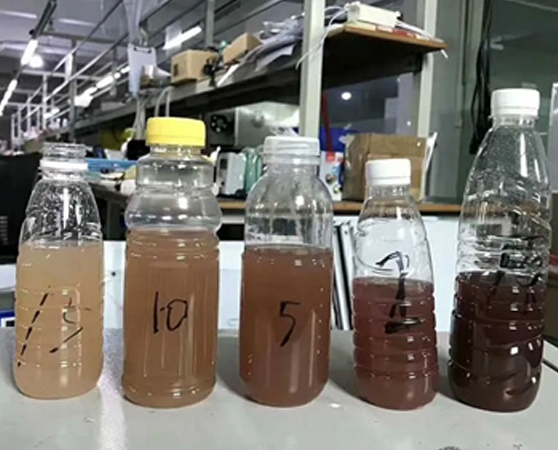
Dissolved organic compounds (DOCs), also known as refractory organics, can significantly impact our aquaculture systems. They give the water a characteristic tea-coloured stain and are non-biodegradable, accumulating according to feed input, water exchange rate, and solids. High levels of DOCs can stress our fish and reduce the biofilter’s nitrification efficiencies, a concern we must address.
- Oxidation into products that are more readily nitrified in the biofilter;
- Including precipitation, which enables the removal of waste particles by conventional filtration or sedimentation.
Removal of Nitrite
Nitrite can accumulate as production intensifies and organic loadings on the biofilter increase. Bacteria that process ammonia into nitrite (Nitrosomonas spp) operate more efficiently under high organic loadings than bacteria that process nitrite to nitrate (Nitrobacter), and nitrite levels rise accordingly.
It’s crucial to note that high nitrite levels can be extremely toxic to our fish. Data available for silver perch Bidyanus biryanis indicates that nitrite levels as low as 2.8 parts per million (ppm) can reduce the growth of fingerlings by 5%, a significant impact we need to prevent.
Ozone removes nitrite by:
- Direct oxidation to nitrate;
- Reducing organic loading, which improves biofiltration efficiency and nitrification.
Disinfection
The high stocking densities, associated fish stress, and increased nutrient loads found in RAS (recirculating aquaculture systems) create an ideal environment for fish pathogens. Standard quarantine procedures for any fish introduced are an essential step in reducing the risk of disease outbreaks in RAS. Facilities using surface waters, including RAS and flow-through hatchery systems, are also interested in reducing the pathogen load introduced via the source water. The disinfection of effluent waters before introduction to the environment is also crucial to prevent the translocation of exotic diseases.
Ozone can effectively inactivate various bacterial, viral, fungal and protozoan fish pathogens. The effectiveness of ozone treatment depends on ozone concentration, length of ozone exposure (contact time), pathogen loads and levels of organic matter. If high levels of organic matter are present, the demand created by oxidizing the organic matter can make it challenging to maintain enough residual ozone for effective disinfection.
How to measure Ozone in your RAS:
The direct ozone measurement in a water sample is generally achieved using colorimetric test kits and spectrophotometry. However, these methods can be too coarse to detect the low residual levels lethal to some fish species and are unsuitable for continuous in-flow monitoring.
A common way of providing some level of constant in-flow monitoring for ozone is using oxidation-reduction potential (ORP) probes. Rather than measure ozone directly, an ORP probe measures the total capacity of various oxidants in millivolts (mV) in a solution to oxidize an electrode. These oxidants, often called ‘total oxidants, ‘include ozone and other reactive species such as chlorine and hydrogen peroxide. Keeping ORP measurements within a specific range, the levels of total oxidants can be controlled, which gives indirect control over ozone. A safe ORP level of freshwater fish culture is generally considered 300 mV.
Many systems automate ozonation by linking ORP measurement and the ozone generator. The generator switches off once the required ORP is reached and cuts back when the ORP drops again. This adaptability of ORP measurement to factors such as pH, temperature, and species culture reassures the system’s effectiveness. However, due to the lack of direct ozone measurement and because ORP probes can take several minutes to register a charge in ORP, any use of ORP to measure and control ozone application is approximate. For this reason, ozone control using ORP measurements is recommended to allow for some error and to set limits conservatively. Other water quality parameters, particularly nitrite, should also be monitored closely with ORP and used to gauge the effect of ozonation.
The Risks
Ozone is an effective oxidizing agent for water treatment and reducing pathogen loads in RAS. However, using any chemical of this nature is accompanied by considerable risks. RAS viability may be threatened in several ways.
- Ozone’s reduction of nitrite levels carries a risk. The biofilter receives less nitrite, and the population of bacteria responsible for processing nitrite to nitrate diminishes. If any ozonation disruption occurs, dangerous nitrite concentration spikes can subsequently develop.
- High residual ozone concentrations risk cultured fish stocks, causing gross tissue damage and stock mortalities.
- High residual ozone concentrations are a risk to bacterial films on the biofilter. Disruption of biofilter performance can cause significant fluctuations in ammonia and nitrite levels. This can have a lethal effect on fish stocks or, at the very least, reduce stock health and growth performance.
It is recommended that a de-ozonation unit be installed directly after ozone application in an RAS to prevent toxic residual levels. This should be done regardless of the location of the ozone application in the system. A simple do-ozonation unit consists of a contact chamber to increase water retention time, allowing ozone to degrade. Alternatively, an in-line activated carbon filter or biofilter can also function as a de-ozonation unit. Degassing of residual ozone also occurs in packed column aerators and trickle filters. Any residual ozone gas should be vented from the RAS building and destroyed before release. Ozone is extremely toxic, and human exposure constitutes a serious health hazard. Decrease in lung function, aggravation of asthma, throat irritation and cough, chest pain, shortness of breath, and inflammation of lung tissue are typical symptoms of ozone exposure. In prolonged or severe exposure cases, chronic respiratory illnesses such as emphysema, chronic bronchitis, and premature aging of the lungs may occur.
Exposure standards for residual ozone in various Australian and international occupational health and safety administrations range between 0.05 and 0.1 ppm for an 8-hour work period and a maximum single dosage of 0.3 ppm for less than 10 minutes. Workcover Australia has a maximum exposure standard for residual ozone of 0.1 ppm for 8 hours.
Therefore, it is important to repeat the requirements of a leak-free ozone reactor made of suitable ozone-resistant materials. Venting sheds or areas of an RAS where ozone is used is also highly recommended. Humans can detect low residual ozone levels as a sharp, pungent odour, but continued exposure can quickly dull the senses. For this reason, perceived odour should not be used as an indicator of ozone presence.